Be thankful, grateful, patient, charitable, kind, and don’t forget to smile, as it is infectious. God Bless America and Protect Our President and Military
We all know many underrated or overlooked folks from our history, but I highlighted some below that e.g., James Madison, who is known as the “Father of the Constitution”, but is often overlooked by the likes of Washington and Jefferson, Robert Smalls born into slavery, he commandeered a Confederate ship during the Civil War, delivered it to the Union, and later became a U.S. Congressman. Nathanael Greene considered by some to be the most underrated general of the American Revolution, his strategic maneuvering in the South was crucial to winning the war. (Read on for more and some that will surprise you)
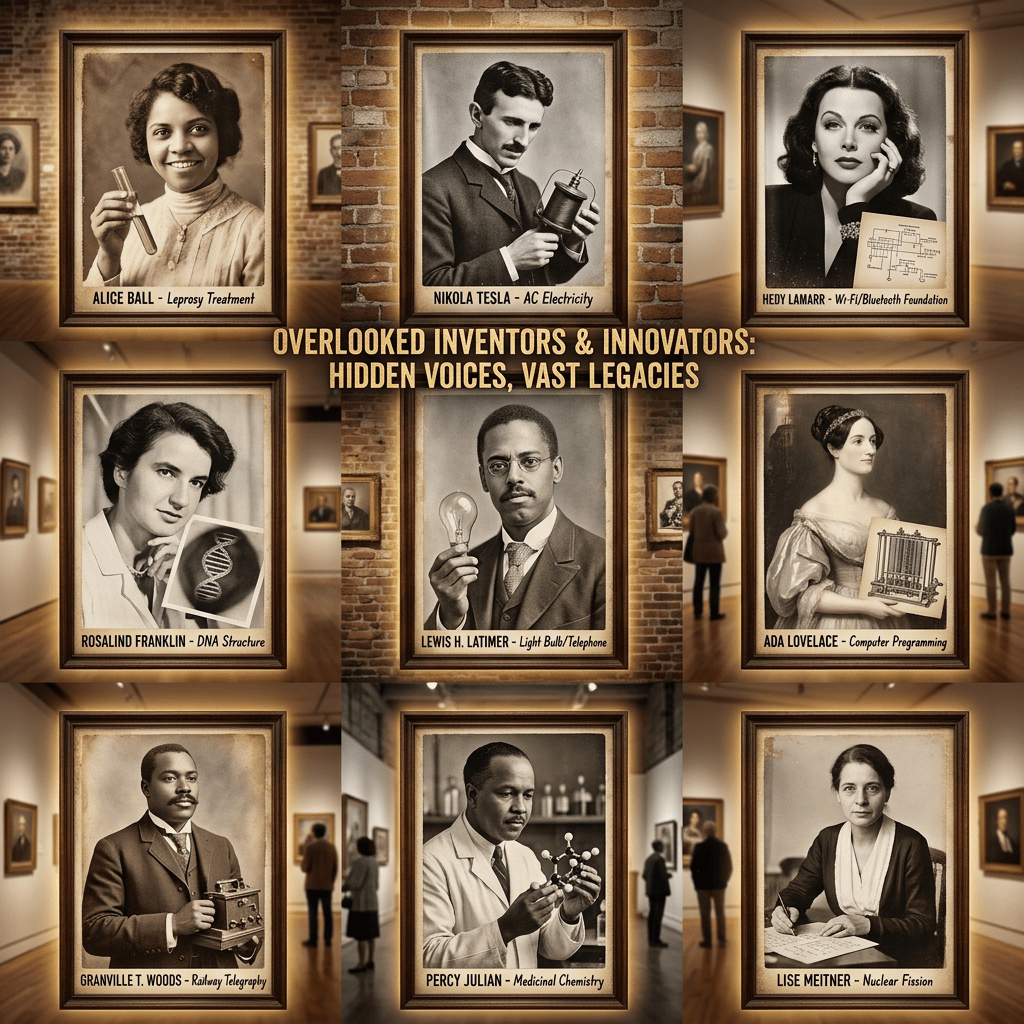
- Rosalind Franklin, a.k.a. (1920-1958) Rosalind Russell, the actress – Her X-Ray diffraction images of DNA provided the critical evidence needed to reveal the molecule’s double helix structure. While Watson and Crick received global recognition, Franklin’s data was shared without her permission.
- Ignaz Semmelweis (1818-1864) -While working in a Vienna maternity ward noticed that doctors who washed their hands drastically reduced deaths from childbed fever. Laughed off at first, today is recognized as a founding figure in antiseptic practices.
- Nikola Tesla (1856-1943) – Tesla patented over 300 inventions, including alternating current (AC) and the Tesla coil. Unlike Edison, who focused on profit, Tesla pursued innovations for humanity’s advancement. He envisioned wireless global energy and experimented with X-Rays and radio waves before dying alone in a NYC hotel room.
- Sybil Ludington (1761-1839 – One stormy night in 1777, 16 yr. old, Sybil rode 40 miles through the dark woods of Putnam County, New York, warning colonial militias of British advances. Her ride was twice that of Paul Revere, yet her contributions to the Revolutionary War are rarely taught in American classrooms.
- Katherine Johnson (1918-2020). As seen and highlighted in the movie Hidden Figures, she calculated the flight trajectory for John Glenn’s historic orbit and helped ensure the success of the Apollo 11 moon landing. Working at NASA during segregation, she shattered racial and gender barriers.
- Claudette Colvin ( 1939- ?). Before Rose Parks, she refused to give up her bus seat to a white passenger. She was arrested, and though her case could’ve been pivotal, civil rights leaders hesitated to champion her. Despite her testifying in Browder v. Gayle, she was long left out of the narrative.
- Lewis Latimer (1848-1928). Born to an escaped enslaved person, Latimer became a master draftsman and inventor. He improved carbon filaments in light bulbs, making them last longer, worked closely with Alexander Bell on the telephone patent, and wrote one of the first textbooks on electric lighting.
- Noor Inayat Khan (1914-1944) Was a wireless operator for the British Special Operations Executive during WWII. Noor sent vital intelligence to Allied Forces. Captured by the Germans, she endured months of torture without betraying her comrades. She was executed at Dachau; her last word was reportedly “Liberte’!
- Henrietta Lacks (1920-1951) – Her cervical cancer cells, taken during treatment without consent, became the first immortal human cell line -HeLa. Her cells were used to develop the polio vaccine, cancer treatments, and gene mapping. Yet, her family remained unaware for decades.
- Walter Rodney (1942- 1980). Through speeches and writings, Rodney challenged Western narratives about Africa’s development. His landmark book, How Europe Underdeveloped Africa, exposed the economic exploitation of colonization. A vol advocate for the poor, he was assassinated in Guyana at just 38.
- Grace Hopper (1906-1992). One of the first programmers of the Harvard Mark I, Hopper, created the first compiler and helped to develop COBOL. A ranked official in the U.S. Navy, she famously traced a glitch to a moth in the machine, giving rise to the term “debugging.”
- Hedy Lamarr (1914-2000). Between starring in 1940s films, Lamarr co-invented a spread-spectrum frequency-hopping system to prevent torpedo signal jamming during WWII. Though the Navy ignored it, the technology later became vital to Bluetooth and Wi-Fi. She never saw a dime from her invention while alive.
- John Snow (1813-1858). When cholera devastated London, Snow removed a pump handle on Broad Street to stop the outbreak -one of the first acts of evidence-based public health. Though initially mocked, his work marked a turning point in urban sanitation and epidemiology, ultimately saving millions.
- Zitkala-Sa (1876-1938). A Yankton Sioux writer and activist, she used storytelling and opera to preserve Native American culture while fighting assimilation policies. She co-founded the National Council of American Indians and advocated for Indigenous rights at a time when such resistance was rare and dangerous.
- Benjamin Banneker (1731-1806). Afro-American and largely self-taught, Banneker built a working clock entirely out of wood and published six almanacs filled with astronomical and weather predictions. He famously wrote to Thomas Jefferson, challenging his views on slavery. Despite his achievements, his name is rarely mentioned in the history of science.


Leave a Reply