


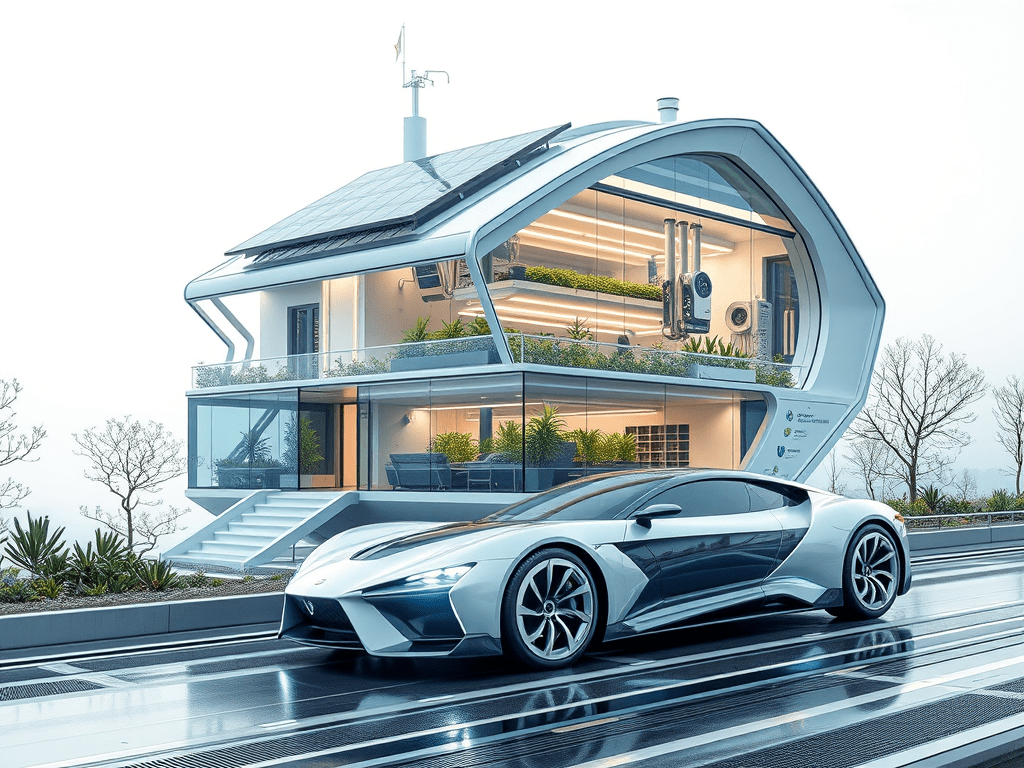
I would implement an idea I had since playing with magnets as a child in the 1960s. My concept involves using advanced, space-age materials to heat and cool road surfaces embedded with magnetized metal shavings. This innovation would allow future vehicles to hover by creating opposing polarizations between the road surface and each vehicle. Each vehicle would be checked from front to back and side to side. The natural repulsion between positive and negative charges on all sides, along with the road surface, would facilitate this hovering effect.
Additionally, an AI computer system would monitor traffic flow, ensuring that all cars move at a consistent pace without obstruction. These vehicles would be driverless and would arrive at the specified time, planned in advance by date and time, and automatically take passengers to their selected destinations.
Housing would be constructed from high-density layered synthetic polymers combined with transparent metal shavings to enhance the strength of polarized glass. This design would incorporate a solar energy system to power all electronics. The glass would be thick and flexible enough to withstand extreme weather conditions such as tornadoes and earthquakes.
Additionally, the structure would feature a state-of-the-art water filtration, cooling, and heating system. It would also include an underground safe room equipped with a hydroponic garden and extra living quarters. Water would be delivered through tubing from the inner layers of the glass, which would collect natural condensation and could also be harvested in cisterns, creating a self-sufficient water supply system.
Each home would be equipped with a robotic surgeon capable of performing prognoses and evaluations of symptoms, and all necessary surgeries, along with robotic nurses to monitor and attend to your every need, aiding in your recovery. The quarters in the home would be separated by polarized glass, which can be darkened at the touch of a button by activating the polarization between the layers of glass. The air in the shelter would be generated by storing oxygen molecules from the water and hydroponic garden, which would also dispense carbon dioxide (CO2) in a similar manner.
The spaceship would be equipped with a rocket capable of carrying six passengers, who would be artificially sustained until it lands on a sun-fed planet with elements that can support life. Upon landing, the ship’s computer would perform calculations and activate automatically, transforming the spaceship into living quarters. It would also manage all processes necessary to safely bring the passengers out of Cryovac status so they can live again.
Point To Ponder: Imagination is an excellent thing of hope, and mine obviously isn’t lacking. However, if any of my readers who have read this prompt and see or hear of any of the above ideas being put to practice, remember that I had them first. Hmm! Maybe I should patent some of these.


Leave a comment