


A man in a Mac drove up in his Compaq, and while enjoying some bites of an apple, his wife looked on as he inquired about a place for a bite to eat that they had heard about. He remarked, “It’s been a long hard drive, adding that I almost crashed twice when a bit of his apple fell to the floor. He winked and noted that the hard drive journey was especially tough on my wife’s software. With a hard stare, she pulled out her Compaq—thankfully it wasn’t a gun—and began to powder her nose. He added with a whisper and another wink, “Hey, lad, have you ever had to reboot in a car that’s so small? It’s no wonder we’ve made it this far.”
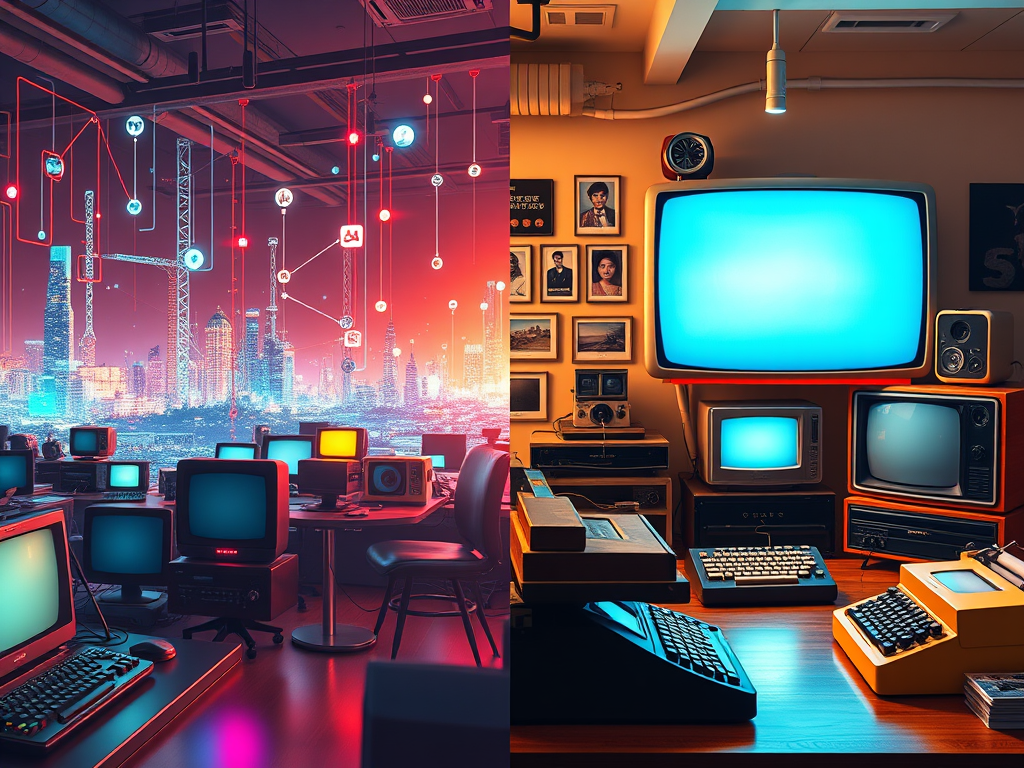
We’ve come a long way since the mid-fifties when I was born, during a time when television was just beginning to emerge. My older siblings still remember listening to the radio. It was a simpler time, marked by the baby boom that followed World War II and the Korean War. Soldiers returned home eager for love, education, jobs, and a sense of normalcy in their lives. Their new focus was on rebuilding—creating bigger, better, and stronger military structures, bridges, high-rises, and roads—with an eye on the skies and beyond.
The world experienced significant advancements in electronics and broadcasting, particularly with television, transistor radios, and Hi-Fi stereos (high fidelity). This progress led to a decline in the large radios that were common in our parents’ generation. At the time, television was primarily in black and white, and we had only four channels: 3, 6, 10, and 12. It wasn’t until around 1965 that UHF technology introduced three additional channels: 17, 29, and 48.
Phones were usually placed on a table alongside a telephone directory, a notepad, and a pen for taking messages. If the line was busy when you called, you would simply hang up and try again later. Kids today probably can’t imagine what it was like to call a girl for a date, especially if her mother—or worse, her father—answered the phone. Back then, many of these dads were war veterans, and you were about to ask for their daughter’s permission to go on a date.
The scenario often unfolded like this: “Hello, this is Mr. Doe. Who is calling?” You’d hang up, gather some courage, and call back later, hoping she or her mother might answer instead! LOL!
We witnessed the emergence of Rock ‘n’ Roll, a genre primarily credited to Chuck Berry, while the popularity of Doo Wop and the renowned Jazz Crooners began to decline. By the 1970s, many artists had faded from the spotlight, with only a few notable names remaining visible on stages, television, and in films. These included Bing Crosby, Perry Como, Dean Martin, Ella Fitzgerald, and Louis Armstrong.
In late 1962, Jack Paar and Dick Cavett introduced The Beatles with little fanfare, as their music had not yet made a significant impact in the United States. The tragic plane crash that killed Buddy Holly, Ritchie Valens, and J.P. “The Big Bopper” Richardson created a void in the music scene, which was further exacerbated by Elvis Presley enlisting in the Army. The Beatles’ debut on The Ed Sullivan Show filled this void, marking the beginning of what is now known as the British Invasion.
After The Beatles, several notable acts emerged, including The Yardbirds (which featured Eric Clapton, Jimmy Page, and Jeff Beck), The Rolling Stones, The Dave Clark Five, The Kinks, The Animals, and Led Zeppelin. One of my favorites, Cream, was formed after the breakup of The Yardbirds.
In the United States, artists such as Bob Dylan, Joan Baez, and Sam Cooke, alongside the rising Motown phenomenon, helped draw attention to Dr. Martin Luther King Jr. and the Civil Rights Movement. During this period, the mood of the country was shifting, influenced by significant events like the Bay of Pigs incident, the assassination of President John F. Kennedy, and the subsequent killing of Lee Harvey Oswald.
The space program, which included the Mercury, Gemini, and Apollo missions, ultimately culminated in Neil Armstrong’s historic step onto the Moon’s surface. He famously said, “That’s one small step for man, one giant leap for mankind.” The year 1968 heralded significant changes in science, technology, music, television, radio, and society as a whole. During this time, Robert F. Kennedy announced his candidacy for president, while Dr. Martin Luther King Jr. delivered his iconic “I Have a Dream” speech. Dr. Timothy Leary and Ralph Abernathy inspired many to protest against the Vietnam War by burning their draft cards, bras, and other symbols of American conformity. It was a year marked by reflection on various issues, including morality within religious institutions, marriage, and societal standards of what was considered acceptable in the media.
I can still remember working on a high school computer that filled an entire room and learning coding through communication with Penn State. Although I never pursued programming languages like COBOL or Fortran, these languages ultimately became integral to our daily lives, almost woven into our very being. Kids today are much better off and more accepting of each other’s race, religion, and beliefs, at least here in the United States.
When I see empty streets where children used to play, half-filled churches, and kids glued to their phones, laptops, and headphones, it makes me reflect. Educational institutions are consumed with debates over religious beliefs as people take sides, while news spreads rapidly, often lacking credibility. Additionally, actors, musicians, and others irresponsibly share their political views with our impressionable youth.
It makes me question if we are truly better off than the kids who grew up in “The Wonder Years,” when everything felt right with the world.


Leave a comment